Kaiming He (Chinese: 何恺明; pinyin: Hé Kǎimíng) is a Chinese computer scientist who primarily researches computer vision and deep learning. He is an associate professor at Massachusetts Institute of Technology and works part-time as a Distinguished Scientist at Google DeepMind. He is known as one of the creators of the residual neural network (ResNet) architecture. == Early life and education == He attended the public Guangzhou Zhixin High School in Guangzhou, Guangdong, China. He scored first place for the total scores in the 2003 Guangdong provincial undergraduate admissions exam. He went to Tsinghua University for undergraduate education and received a Bachelor of Science degree in 2007. In 2007 to 2011, he pursued doctoral studies in information engineering at the Chinese University of Hong Kong at its Multimedia Laboratory, receiving a PhD degree in 2011. His doctoral dissertation was titled Single image haze removal using dark channel prior (2011), and his doctoral adviser was Tang Xiao'ou. == Career == He worked at Microsoft Research Asia from 2011 to 2016 and at Facebook Artificial Intelligence Research from 2016 to 2024. In 2024, he became an associate professor at the Department of Electrical Engineering and Computer Science of the Massachusetts Institute of Technology. His 2016 paper Deep Residual Learning for Image Recognition is the most cited research paper in 5 years according to Google Scholar's reports in 2020 and 2021. == Awards and recognitions == He won ICCV's best paper award (Marr Prize) in 2017 and CVPR's best paper award in 2009 and 2016. He was awarded the 2023 Future Science Prize along with 3 collaborators for "fundamental contribution to artificial intelligence by introducing deep residual learning".
Exposure Notification
The (Google/Apple) Exposure Notification System (GAEN) is a framework and protocol specification developed by Apple Inc. and Google to facilitate digital contact tracing during the COVID-19 pandemic. When used by health authorities, it augments more traditional contact tracing techniques by automatically logging close approaches among notification system users using Android or iOS smartphones. Exposure Notification is a decentralized reporting protocol built on a combination of Bluetooth Low Energy technology and privacy-preserving cryptography. It is an opt-in feature within COVID-19 apps developed and published by authorized health authorities. Unveiled on April 10, 2020, it was made available on iOS on May 20, 2020, as part of the iOS 13.5 update and on December 14, 2020, as part of the iOS 12.5 update for older iPhones. On Android, it was added to devices via a Google Play Services update, supporting all versions since Android Marshmallow. The Apple/Google protocol is similar to the Decentralized Privacy-Preserving Proximity Tracing (DP-3T) protocol created by the European DP-3T consortium and the Temporary Contact Number (TCN) protocol by Covid Watch, but is implemented at the operating system level, which allows for more efficient operation as a background process. Since May 2020, a variant of the DP-3T protocol is supported by the Exposure Notification Interface. Other protocols are constrained in operation because they are not privileged over normal apps. This leads to issues, particularly on iOS devices where digital contact tracing apps running in the background experience significantly degraded performance. The joint approach is also designed to maintain interoperability between Android and iOS devices, which constitute nearly all of the market. The ACLU stated the approach "appears to mitigate the worst privacy and centralization risks, but there is still room for improvement". In late April, Google and Apple shifted the emphasis of the naming of the system, describing it as an "exposure notification service", rather than "contact tracing" system. == Technical specification == Digital contact tracing protocols typically have two major responsibilities: encounter logging and infection reporting. Exposure Notification only involves encounter logging which is a decentralized architecture. The majority of infection reporting is centralized in individual app implementations. To handle encounter logging, the system uses Bluetooth Low Energy to send tracking messages to nearby devices running the protocol to discover encounters with other people. The tracking messages contain unique identifiers that are encrypted with a secret daily key held by the sending device. These identifiers change every 15–20 minutes as well as Bluetooth MAC address in order to prevent tracking of clients by malicious third parties through observing static identifiers over time. The sender's daily encryption keys are generated using a random number generator. Devices record received messages, retaining them locally for 14 days. If a user tests positive for infection, the last 14 days of their daily encryption keys can be uploaded to a central server, where it is then broadcast to all devices on the network. The method through which daily encryption keys are transmitted to the central server and broadcast is defined by individual app developers. The Google-developed reference implementation calls for a health official to request a one-time verification code (VC) from a verification server, which the user enters into the encounter logging app. This causes the app to obtain a cryptographically signed certificate, which is used to authorize the submission of keys to the central reporting server. The received keys are then provided to the protocol, where each client individually searches for matches in their local encounter history. If a match meeting certain risk parameters is found, the app notifies the user of potential exposure to the infection. Google and Apple intend to use the received signal strength (RSSI) of the beacon messages as a source to infer proximity. RSSI and other signal metadata will also be encrypted to resist deanonymization attacks. === Version 1.0 === To generate encounter identifiers, first a persistent 32-byte private Tracing Key ( t k {\displaystyle tk} ) is generated by a client. From this a 16 byte Daily Tracing Key is derived using the algorithm d t k i = H K D F ( t k , N U L L , 'CT-DTK' | | D i , 16 ) {\displaystyle dtk_{i}=HKDF(tk,NULL,{\text{'CT-DTK'}}||D_{i},16)} , where H K D F ( Key, Salt, Data, OutputLength ) {\displaystyle HKDF({\text{Key, Salt, Data, OutputLength}})} is a HKDF function using SHA-256, and D i {\displaystyle D_{i}} is the day number for the 24-hour window the broadcast is in starting from Unix Epoch Time. These generated keys are later sent to the central reporting server should a user become infected. From the daily tracing key a 16-byte temporary Rolling Proximity Identifier is generated every 10 minutes with the algorithm R P I i , j = Truncate ( H M A C ( d t k i , 'CT-RPI' | | T I N j ) , 16 ) {\displaystyle RPI_{i,j}={\text{Truncate}}(HMAC(dtk_{i},{\text{'CT-RPI'}}||TIN_{j}),16)} , where H M A C ( Key, Data ) {\displaystyle HMAC({\text{Key, Data}})} is a HMAC function using SHA-256, and T I N j {\displaystyle TIN_{j}} is the time interval number, representing a unique index for every 10 minute period in a 24-hour day. The Truncate function returns the first 16 bytes of the HMAC value. When two clients come within proximity of each other they exchange and locally store the current R P I i , j {\displaystyle RPI_{i,j}} as the encounter identifier. Once a registered health authority has confirmed the infection of a user, the user's Daily Tracing Key for the past 14 days is uploaded to the central reporting server. Clients then download this report and individually recalculate every Rolling Proximity Identifier used in the report period, matching it against the user's local encounter log. If a matching entry is found, then contact has been established and the app presents a notification to the user warning them of potential infection. === Version 1.1 === Unlike version 1.0 of the protocol, version 1.1 does not use a persistent tracing key, rather every day a new random 16-byte Temporary Exposure Key ( t e k i {\displaystyle tek_{i}} ) is generated. This is analogous to the daily tracing key from version 1.0. Here i {\displaystyle i} denotes the time is discretized in 10 minute intervals starting from Unix Epoch Time. From this two 128-bit keys are calculated, the Rolling Proximity Identifier Key ( R P I K i {\displaystyle RPIK_{i}} ) and the Associated Encrypted Metadata Key ( A E M K i {\displaystyle AEMK_{i}} ). R P I K i {\displaystyle RPIK_{i}} is calculated with the algorithm R P I K i = H K D F ( t e k i , N U L L , 'EN-RPIK' , 16 ) {\displaystyle RPIK_{i}=HKDF(tek_{i},NULL,{\text{'EN-RPIK'}},16)} , and A E M K i {\displaystyle AEMK_{i}} using the algorithm A E M K i = H K D F ( t e k i , N U L L , 'EN-AEMK' , 16 ) {\displaystyle AEMK_{i}=HKDF(tek_{i},NULL,{\text{'EN-AEMK'}},16)} . From these values a temporary Rolling Proximity Identifier ( R P I i , j {\displaystyle RPI_{i,j}} ) is generated every time the BLE MAC address changes, roughly every 15–20 minutes. The following algorithm is used: R P I i , j = A E S 128 ( R P I K i , 'EN-RPI' | | 0 x 000000000000 | | E N I N j ) {\displaystyle RPI_{i,j}=AES128(RPIK_{i},{\text{'EN-RPI'}}||{\mathtt {0x000000000000}}||ENIN_{j})} , where A E S 128 ( Key, Data ) {\displaystyle AES128({\text{Key, Data}})} is an AES cryptography function with a 128-bit key, the data is one 16-byte block, j {\displaystyle j} denotes the Unix Epoch Time at the moment the roll occurs, and E N I N j {\displaystyle ENIN_{j}} is the corresponding 10-minute interval number. Next, additional Associated Encrypted Metadata is encrypted. What the metadata represents is not specified, likely to allow the later expansion of the protocol. The following algorithm is used: Associated Encrypted Metadata i , j = A E S 128 _ C T R ( A E M K i , R P I i , j , Metadata ) {\displaystyle {\text{Associated Encrypted Metadata}}_{i,j}=AES128\_CTR(AEMK_{i},RPI_{i,j},{\text{Metadata}})} , where A E S 128 _ C T R ( Key, IV, Data ) {\displaystyle AES128\_CTR({\text{Key, IV, Data}})} denotes AES encryption with a 128-bit key in CTR mode. The Rolling Proximity Identifier and the Associated Encrypted Metadata are then combined and broadcast using BLE. Clients exchange and log these payloads. Once a registered health authority has confirmed the infection of a user, the user's Temporary Exposure Keys t e k i {\displaystyle tek_{i}} and their respective interval numbers i {\displaystyle i} for the past 14 days are uploaded to the central reporting server. Clients then download this report and individually recalculate every Rolling Proximity Identifier starting from interval number i {\displaystyle i} ,
Bazaart
Bazaart is an AI-powered design platform with image and video editing capabilities for iOS, Android, MacOS, and the web. == History == Bazaart was founded in 2012 in Israel. In April 2012, Bazaart launched a Facebook app called Pinvolve, which converts Facebook Pages into Pinterest pinboards. From June to August 2012, it participated in the DreamIt startup accelerator in New York and raised $25,000 from the accelerator. In July 2012, it launched its first version as an iPad app connected to Pinterest. In December 2013, it pivoted and launched a major version of its app, a "social" photoshop that allowed users to edit images which could be pulled in from the camera roll, social networks, and other sources. In July 2014, Bazaart reached one million downloads and in December was selected by Apple as Best of 2014. In 2015, Bazaart added Photoshop integration in a partnership with Adobe. In September 2020, Bazaart launched an Android app. In December 2020, Bazaart was selected by Google as Best of 2020. In January 2022, Bazaart added video editing capabilities. In 2023, the platform added AI-powered backgrounds and video background removal features.
Educational robotics
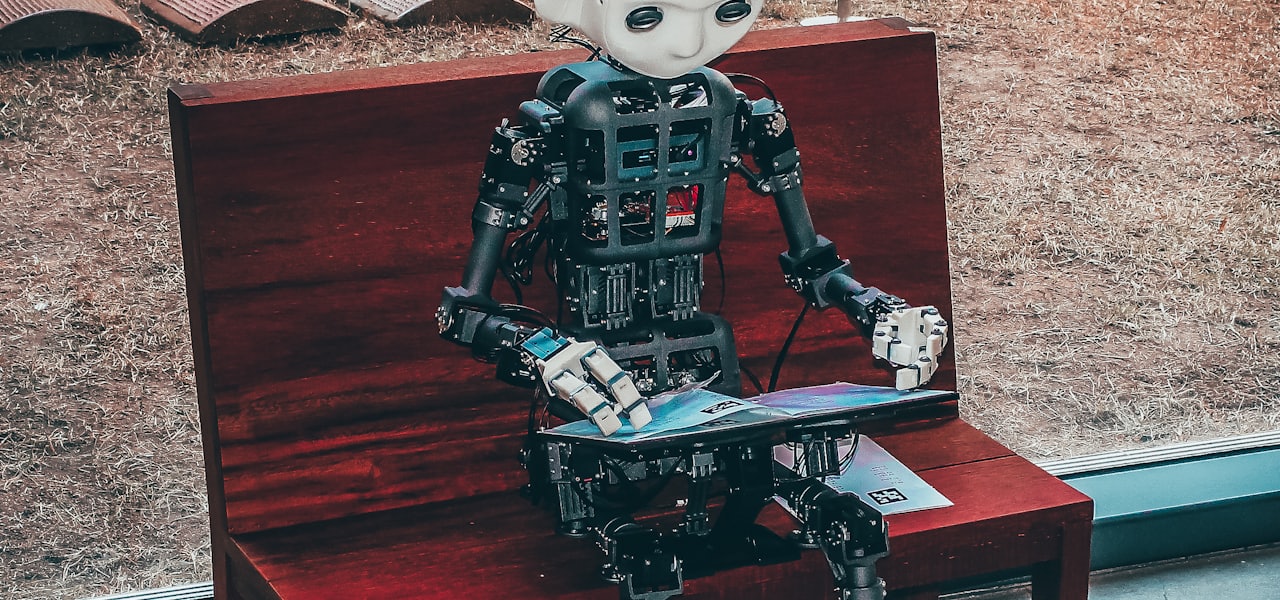
Educational robotics teaches the design, analysis, application and operation of robots. Robots include articulated robots, mobile robots or autonomous vehicles. Educational robotics can be taught from elementary school to graduate programs. Robotics may also be used to motivate and facilitate the instruction other, often foundational, topics such as computer programming, artificial intelligence or engineering design. == Education and training == Robotics engineers design robots, maintain them, develop new applications for them, and conduct research to expand the potential of robotics. Robots have become a popular educational tool in some middle and high schools, as well as in numerous youth summer camps, raising interest in programming, artificial intelligence and robotics among students. First-year computer science courses at several universities now include programming of a robot in addition to traditional software engineering-based coursework. == Category of Educational robotics == The categories of educational robots seen as having more than one category. It can be alienated into different categories based on their physical design and coding method. Generally they are categorised as arm robots, wheeled mobile robots and humanoid robots. Tangibly, coded robots uses a physical means of coding instead of the screens coding. === Initiatives in schools === Leachim, was a robot teacher programmed with the class curricular, as well as certain biographical information on the 40 students whom it was programmed to teach. Leachim could synthesize human speech using Diphone synthesis. It was invented by Michael J. Freeman in 1974 and was tested in a fourth grade classroom in the Bronx, New York. === Post-secondary degree programs === From approximately 1960 through 2005, robotics education at post-secondary institutions took place through elective courses, thesis experiences and design projects offered as part of degree programs in traditional academic disciplines, such as mechanical engineering, electrical engineering, industrial engineering or computer science. Since 2005, more universities have begun granting degrees in robotics as a discipline in its own right, often under the name "Robotic Engineering". Based on a 2015 web-based survey of robotics educators, the degree programs and their estimates annual graduates are listed alphabetically below. Note that only official degree programs where the word "robotics" appears on the transcript or diploma are listed here; whereas degree programs in traditional disciplines with course concentrations or thesis topics related to robotics are deliberately omitted. === Certification === The Robotics Certification Standards Alliance (RCSA) is an international robotics certification authority that confers various industry- and educational-related robotics certifications. === Summer robotics camp === Several summer camp programs include robotics as part of their core curriculum. In addition, youth summer robotics programs are frequently offered by celebrated museums such as the American Museum of Natural History and The Tech Museum of Innovation in Silicon Valley, CA, just to name a few. There are of benefits that come from attending robotics camps. It teaches students how to use teamwork, resilience and motivation, and decision-making. Students learn teamwork because most camps involve exciting activities requiring teamwork. Resilience and motivation is expected because by completing the challenging programs, students feel talented and accomplished after they complete the program. Also students are given unique situations making them make decisions to further their situation. === Educational robotics in special education === Educational robotics can be a useful tool in early and special education. According to a journal on new perspectives in science education, educational robotics can help to develop abilities that promote autonomy and assist their integration into society. Social and personal skills can also be developed through educational robotics. Using Lego Mindstorms NXT, schoolteachers were able to work with middle school aged children in order to develop programs and improve the children's social and personal skills. Additionally, problem solving skills and creativity were utilized through the creation of artwork and scenery to house the robots. Other studies show the benefits of educational robotics in special education as promoting superior cognitive functions, including executive functions. This can lead to an increased ability in "problem solving, reasoning and planning in typically developing preschool children." Through eight weeks of weekly forty-five-minute group sessions using the Bee-Bot, an increase in interest, attention, and interaction between both peers and adults was found in the school and preschool-aged children with Down Syndrome. This study suggests that educational robotics in the classroom can also lead to an improvement in visuo-spatial memory and mental planning. Furthermore, executive functions seemed to be possible in one child during this study.
Couch to 5K
Couch to 5K, abbreviated C25K, is an exercise plan that gradually progresses from beginner running toward a 5 kilometre (3.1 mile) run over nine weeks. == Operations == The Couch to 5K running plan, also known as C25K, created by Josh Clark in 1996, was developed with the expectation of creating a plan for new runners to start running. The plan is aimed to have users work out for 20 to 30 minutes, three days a week. Within the program, users can be expected to perform different tasks such as intervals of running with period of short walks in between to help build endurance in the weeks up to the final goal of a 5K run. During the nine weeks leading up to the race, the runner will learn to set their own pace and where their strengths and weaknesses are within running. Often, the daily workouts start with a five-minute warm-up walk and works up to running five kilometres without a walking break within nine weeks. Users are not expected to have any experience in running and can be some of the first running that they ever do. The main goal is to turn that unexperienced runner into someone who can run a 5K. Clark started the website Kick and featured C25K on the site. In 2001, Kick merged with Cool Running, a New England–based running site. Clark later sold his stake in Cool Running and the Couch to 5K program. Cool Running was absorbed into Active.com, operated by Active Network, LLC. Active Network provides mobile apps for Couch to 5K, as well as 5K to 10K, a follow-up program. The NHS in the UK provides downloadable podcasts and a smartphone app (Android and iOS) for the plan. A mobile app, created by Zen Labs, has training plans that are based on the Couch to 5K running plan from CoolRunning.com. It is one of the highest-rated health and fitness apps available on Android and iOS. As of 2016, the C25K app has been used by over 5 million people.
Imaging phantom
An imaging phantom, or simply phantom (less commonly spelled fantom), is a specially designed object that is scanned or imaged in the field of medical imaging to evaluate, analyze, and tune the performance of various imaging devices. A phantom is more readily available and provides more consistent results than the use of a living subject or cadaver, while also avoiding direct risks to living subjects. Phantoms were originally employed in 2D x-ray–based imaging techniques such as radiography or fluoroscopy, but more recently phantoms with desired imaging characteristics have been developed for 3D techniques such as SPECT, MRI, CT, ultrasound, PET, and other imaging modalities. == Design == A phantom used to evaluate an imaging device should respond in a similar manner to how human tissues and organs would act in that specific imaging modality. For instance, phantoms made for 2D radiography may hold various quantities of x-ray contrast agents with similar x-ray absorbing properties (such as the attenuation coefficient) to normal tissue to tune the contrast of the imaging device or modulate the patient's exposure to radiation. In such a case, the radiography phantom would not necessarily need to have similar textures and mechanical properties since these are not relevant in x-ray imaging modalities. However, in the case of ultrasonography, a phantom with similar rheological and ultrasound scattering properties to real tissue would be essential, but x-ray absorbing properties would not be relevant. The term "phantom" describes an object that is designed to resemble human tissue and can be evaluated, analyzed or manipulated to study the performance of a medical device. Phantoms are created using a digital file that is rendered through magnetic resonance imaging (MRI) or computer-aided design (CAD). The digital files allow for quick modifications that are read by the 3D printer. The 3D printer will create the product in successive layers using polymeric materials. There are several types of phantoms including tissue-mimicking, radiological phantoms, dental phantoms, BOMABs (used to calibrate whole-body counters), and more.
Multisample anti-aliasing
Multisample anti-aliasing (MSAA) is a type of spatial anti-aliasing, a technique used in computer graphics to remove jaggies. It is an optimization of supersampling, where only the necessary parts are sampled more. Jaggies are only noticed in a small area, so the area is quickly found, and only that is anti-aliased. == Definition == The term generally refers to a special case of supersampling. Initial implementations of full-scene anti-aliasing (FSAA) worked conceptually by simply rendering a scene at a higher resolution, and then downsampling to a lower-resolution output. Most modern GPUs are capable of this form of anti-aliasing, but it greatly taxes resources such as texture, bandwidth, and fillrate. (If a program is highly TCL-bound or CPU-bound, supersampling can be used without much performance hit.) According to the OpenGL GL_ARB_multisample specification, "multisampling" refers to a specific optimization of supersampling. The specification dictates that the renderer evaluate the fragment program once per pixel, and only "truly" supersample the depth and stencil values. (This is not the same as supersampling but, by the OpenGL 1.5 specification, the definition had been updated to include fully supersampling implementations as well.) In graphics literature in general, "multisampling" refers to any special case of supersampling where some components of the final image are not fully supersampled. The lists below refer specifically to the ARB_multisample definition. == Description == In supersample anti-aliasing, multiple locations are sampled within every pixel, and each of those samples is fully rendered and combined with the others to produce the pixel that is ultimately displayed. This is computationally expensive, because the entire rendering process must be repeated for each sample location. It is also inefficient, as aliasing is typically only noticed in some parts of the image, such as the edges, whereas supersampling is performed for every single pixel. In multisample anti-aliasing, if any of the multi sample locations in a pixel is covered by the triangle being rendered, a shading computation must be performed for that triangle. However this calculation only needs to be performed once for the whole pixel regardless of how many sample positions are covered; the result of the shading calculation is simply applied to all of the relevant multi sample locations. In the case where only one triangle covers every multi sample location within the pixel, only one shading computation is performed, and these pixels are little more expensive than (and the result is no different from) the non-anti-aliased image. This is true of the middle of triangles, where aliasing is not an issue. (Edge detection can reduce this further by explicitly limiting the MSAA calculation to pixels whose samples involve multiple triangles, or triangles at multiple depths.) In the extreme case where each of the multi sample locations is covered by a different triangle, a different shading computation will be performed for each location and the results then combined to give the final pixel, and the result and computational expense are the same as in the equivalent supersampled image. The shading calculation is not the only operation that must be performed on a given pixel; multisampling implementations may variously sample other operations such as visibility at different sampling levels. == Advantages == The pixel shader usually only needs to be evaluated once per pixel for every triangle covering at least one sample point. The edges of polygons (the most obvious source of aliasing in 3D graphics) are anti-aliased. Since multiple subpixels per pixel are sampled, polygonal details smaller than one pixel that might have been missed without MSAA can be captured and made a part of the final rendered image if enough samples are taken. == Disadvantages == === Alpha testing === Alpha testing is a technique common to older video games used to render translucent objects by rejecting pixels from being written to the framebuffer. If the alpha value of a translucent fragment (pixel) is below a specified threshold, it will be discarded. Because this is performed on a pixel by pixel basis, the image does not receive the benefits of multi-sampling (all of the multisamples in a pixel are discarded based on the alpha test) for these pixels. The resulting image may contain aliasing along the edges of transparent objects or edges within textures, although the image quality will be no worse than it would be without any anti-aliasing. Translucent objects that are modelled using alpha-test textures will also be aliased due to alpha testing. This effect can be minimized by rendering objects with transparent textures multiple times, although this would result in a high performance reduction for scenes containing many transparent objects. === Aliasing === Because multi-sampling calculates interior polygon fragments only once per pixel, aliasing and other artifacts will still be visible inside rendered polygons where fragment shader output contains high frequency components. === Performance === While less performance-intensive than SSAA (supersampling), it is possible in certain scenarios (scenes heavy in complex fragments) for MSAA to be multiple times more intensive for a given frame than post processing anti-aliasing techniques such as FXAA, SMAA and MLAA. Early techniques in this category tend towards a lower performance impact, but suffer from accuracy problems. More recent post-processing based anti-aliasing techniques such as temporal anti-aliasing (TAA), which reduces aliasing by combining data from previously rendered frames, have seen the reversal of this trend, as post-processing AA becomes both more versatile and more expensive than MSAA, which cannot antialias an entire frame alone. == Sampling methods == === Point sampling === In a point-sampled mask, the coverage bit for each multisample is only set if the multisample is located inside the rendered primitive. Samples are never taken from outside a rendered primitive, so images produced using point-sampling will be geometrically correct, but filtering quality may be low because the proportion of bits set in the pixel's coverage mask may not be equal to the proportion of the pixel that is actually covered by the fragment in question. === Area sampling === Filtering quality can be improved by using area sampled masks. In this method, the number of bits set in a coverage mask for a pixel should be proportionate to the actual area coverage of the fragment. This will result in some coverage bits being set for multisamples that are not actually located within the rendered primitive, and can cause aliasing and other artifacts. == Sample patterns == === Regular grid === A regular grid sample pattern, where multisample locations form an evenly spaced grid throughout the pixel, is easy to implement and simplifies attribute evaluation (i.e. setting subpixel masks, sampling color and depth). This method is computationally expensive due to the large number of samples. Edge optimization is poor for screen-aligned edges, but image quality is good when the number of multisamples is large. === Sparse regular grid === A sparse regular grid sample pattern is a subset of samples that are chosen from the regular grid sample pattern. As with the regular grid, attribute evaluation is simplified due to regular spacing. The method is less computationally expensive due to having a fewer samples. Edge optimization is good for screen aligned edges, and image quality is good for a moderate number of multisamples. === Stochastic sample patterns === A stochastic sample pattern is a random distribution of multisamples throughout the pixel. The irregular spacing of samples makes attribute evaluation complicated. The method is cost efficient due to low sample count (compared to regular grid patterns). Edge optimization with this method, although sub-optimal for screen aligned edges. Image quality is excellent for a moderate number of samples. == Quality == Compared to supersampling, multisample anti-aliasing can provide similar quality at higher performance, or better quality for the same performance. Further improved results can be achieved by using rotated grid subpixel masks. The additional bandwidth required by multi-sampling is reasonably low if Z and colour compression are available. Most modern GPUs support 2×, 4×, and 8× MSAA samples. Higher values result in better quality, but are slower.