EasyChair is a web-based conference management software system. It has been used since 2002 in the scientific community for tasks such as organising research paper submission and review. In 2012, EasyChair added an open access online publication service for conference proceedings. == Description == EasyChair is a paid web-based conference management software system used, among other tasks, to organize paper submission and review, similar to other event management system software such as OpenConf. EasyChair used to be run by the Department of Computer Science at the University of Manchester but now it is a commercial service, owned by EasyChair Ltd. in Stockport (established 2016). EasyChair used to be free, for standard service, but as of 2022, only minimal services are free. The EasyChair website also provides an open access online publication service for conference proceedings. When launched in 2012, the service was for computer science only, but in 2016 it was expanded to all sciences. == History == The EasyChair software has been in continuous development since 2002. As of 2015, the code base consists of nearly 300,000 lines of code, and it has been used by more than 41,000 conferences. More than two and a half million users in the scientific community reported using it in 2019.
Artificial intelligence of things
Artificial Intelligence of Things (AIoT) is the combination of artificial intelligence (AI) technologies with the Internet of things (IoT) infrastructure to create systems capable of sensing, learning, and acting on data without continuous human intervention. While IoT focuses on connectivity and sensor data collection, AI enables IoT devices to analyse data in real time and produce actionable outputs, including automated decisions at the edge. == Applications == === Manufacturing and predictive maintenance === Manufacturing accounts for the largest share of AIoT adoption by industry vertical. A common application is predictive maintenance, where sensors measuring vibration, temperature, current draw, and acoustic emissions feed machine learning models trained to detect signatures that precede equipment failure. These systems can flag developing faults weeks or months in advance, and in more advanced deployments can autonomously adjust machine parameters such as motor speed or cooling cycles to delay or prevent failure. === Other industries === In healthcare, AIoT enables remote patient monitoring through wearable devices that collect vital signs and apply AI models to detect anomalies or predict deterioration. In logistics, GPS and telematics sensors combined with AI models support real-time route optimisation, vehicle maintenance prediction, and fuel cost forecasting. Smart building systems use occupancy, temperature, and energy sensors with AI to dynamically adjust HVAC and lighting, reducing energy consumption. == Architecture == AIoT systems typically operate across three layers: a device layer of sensors and actuators that collect data, a connectivity layer that transmits data via protocols such as MQTT or HTTP, and a compute layer where AI models process the data either in the cloud or at the edge. The trend toward edge-based processing, where inference runs on low-cost processors near the data source rather than in a centralised cloud, has accelerated as hardware costs have fallen and applications increasingly require sub-second response times. == Market == Market sizing estimates for AIoT vary significantly depending on scope and definition. Fortune Business Insights valued the AIoT market at USD 35.65 billion in 2023, projecting growth to USD 253.86 billion by 2030 at a compound annual growth rate of 32.4%. Grand View Research estimated the broader market at USD 171.4 billion in 2024 with a CAGR of 31.7% through 2030, reflecting a wider definition that includes AI-integrated hardware components. North America accounted for approximately 40% of global market share in 2024, with the Asia-Pacific region projected as the fastest-growing market.
Glushkov's construction algorithm
In computer science theory – particularly formal language theory – Glushkov's construction algorithm, invented by Victor Mikhailovich Glushkov, transforms a given regular expression into an equivalent nondeterministic finite automaton (NFA). Thus, it forms a bridge between regular expressions and nondeterministic finite automata: two abstract representations of the same class of formal languages. A regular expression may be used to conveniently describe an advanced search pattern in a "find and replace"–like operation of a text processing utility. Glushkov's algorithm can be used to transform it into an NFA, which furthermore is small by nature, as the number of its states equals the number of symbols of the regular expression, plus one. Subsequently, the NFA can be made deterministic by the powerset construction and then be minimized to get an optimal automaton corresponding to the given regular expression. The latter format is best suited for execution on a computer. From another, more theoretical point of view, Glushkov's algorithm is a part of the proof that NFA and regular expressions both accept exactly the same languages; that is, the regular languages. The converse of Glushkov's algorithm is Kleene's algorithm, which transforms a finite automaton into a regular expression. The automaton obtained by Glushkov's construction is the same as the one obtained by Thompson's construction algorithm, once its ε-transitions are removed. Glushkov's construction algorithm is also called The algorithm of Berry-Sethi, named after Gérard Berry and Ravi Sethi who worked on this construction. == Construction == Given a regular expression e, the Glushkov Construction Algorithm creates a non-deterministic automaton that accepts the language L ( e ) {\displaystyle L(e)} accepted by e. The construction uses four steps: === Step 1 === Linearisation of the expression. Each letter of the alphabet appearing in the expression e is renamed, so that each letter occurs at most once in the new expression e ′ {\displaystyle e'} . Glushkov's construction essentially relies on the fact that e ′ {\displaystyle e'} represents a local language L ( e ′ ) {\displaystyle L(e')} . Let A be the old alphabet and let B be the new one. === Step 2a === Computation of the sets P ( e ′ ) {\displaystyle P(e')} , D ( e ′ ) {\displaystyle D(e')} , and F ( e ′ ) {\displaystyle F(e')} . The first, P ( e ′ ) {\displaystyle P(e')} , is the set of letters which occurs as first letter of a word of L ( e ′ ) {\displaystyle L(e')} . The second, D ( e ′ ) {\displaystyle D(e')} , is the set of letters that can end a word of L ( e ′ ) {\displaystyle L(e')} . The last one, F ( e ′ ) {\displaystyle F(e')} , is the set of letter pairs that can occur in words of L ( e ′ ) {\displaystyle L(e')} , i.e. it is the set of factors of length two of the words of L ( e ′ ) {\displaystyle L(e')} . Those sets are mathematically defined by P ( e ′ ) = { x ∈ B ∣ x B ∗ ∩ L ( e ′ ) ≠ ∅ } {\displaystyle P(e')=\{x\in B\mid xB^{}\cap L(e')\neq \emptyset \}} , D ( e ′ ) = { y ∈ B ∣ B ∗ y ∩ L ( e ′ ) ≠ ∅ } {\displaystyle D(e')=\{y\in B\mid B^{}y\cap L(e')\neq \emptyset \}} , F ( e ′ ) = { u ∈ B 2 ∣ B ∗ u B ∗ ∩ L ( e ′ ) ≠ ∅ } {\displaystyle F(e')=\{u\in B^{2}\mid B^{}uB^{}\cap L(e')\neq \emptyset \}} . They are computed by induction over the structure of the expression, as explained below. === Step 2b === Computation of the set Λ ( e ′ ) {\displaystyle \Lambda (e')} which contains the empty word ε {\displaystyle \varepsilon } if this word belongs to L ( e ′ ) {\displaystyle L(e')} , and is the empty set otherwise. Formally, this is Λ ( e ′ ) = { ε } ∩ L ( e ′ ) {\displaystyle \Lambda (e')=\{\varepsilon \}\cap L(e')} . === Step 3 === Computation of automaton recognizing the local language, as defined by P ( e ′ ) {\displaystyle P(e')} , D ( e ′ ) {\displaystyle D(e')} , F ( e ′ ) {\displaystyle F(e')} , and Λ ( e ′ ) {\displaystyle \Lambda (e')} . By definition, the local language defined by the sets P, D, and F is the set of words which begin with a letter of P, end by a letter of D, and whose factors of length 2 belong to F, optionally also including the empty word; that is, it is the language: L ′ = ( P B ∗ ∩ B ∗ D ) ∖ B ∗ ( B 2 ∖ F ) B ∗ ∪ Λ ( e ′ ) {\displaystyle L'=(PB^{}\cap B^{}D)\setminus B^{}(B^{2}\setminus F)B^{}\cup \Lambda (e')} . Strictly speaking, it is the computation of the automaton for the local language denoted by this linearised expression that is Glushkov's construction. === Step 4 === Remove the linearisation, replacing each indexed letter B by the original letter of A. == Example == Consider the regular expression e = ( a ( a b ) ∗ ) ∗ + ( b a ) ∗ {\displaystyle e=(a(ab)^{})^{}+(ba)^{}} . == Computation of the set of letters == The computation of the sets P, D, F, and Λ is done inductively over the regular expression e ′ {\displaystyle e'} . One must give the values for ∅, ε (the symbols for the empty language and the singleton language containing the empty word), the letters, and the results of the operations + , ⋅ , ∗ {\displaystyle +,\cdot ,^{}} . The most costly operations are the cartesian products of sets for the computation of F. == Properties == The obtained automaton is non-deterministic, and it has as many states as the number of letters of the regular expression, plus one. It has been proven that every Thompson's automaton can be transformed into Glushkov's automaton via a ε-transitions elimination method. == Applications and deterministic expressions == The computation of the automaton by the expression occurs often; it has been systematically used in search functions, in particular by the Unix grep command. Similarly, XML's specification also uses such constructions; for more efficiency, regular expressions of a certain kind, called deterministic expressions, have been studied.
Ocrad
Ocrad is an optical character recognition program and part of the GNU Project. It is free software licensed under the GNU GPL. Based on a feature extraction method, it reads images in portable pixmap formats known as Portable anymap and produces text in byte (8-bit) or UTF-8 formats. Also included is a layout analyser, able to separate the columns or blocks of text normally found on printed pages. == User interface == Ocrad can be used as a stand-alone command-line application or as a back-end to other programs. Kooka, which was the KDE environment's default scanning application until KDE 4, can use Ocrad as its OCR engine. Since conversion to newer Qt versions, current versions of KDE no longer contain Kooka; development continues in the KDE git repository. Ocrad can be also used as an OCR engine in OCRFeeder. == History == Ocrad has been developed by Antonio Diaz Diaz since 2003. Version 0.7 was released in February 2004, 0.14 in February 2006 and 0.18 in May 2009. It is written in C++. Archives of the bug-ocrad mailing list go back to October 2003.
Statistical machine translation
Statistical machine translation (SMT) is a machine translation approach where translations are generated on the basis of statistical models whose parameters are derived from the analysis of bilingual text corpora. The statistical approach contrasts with the rule-based approaches to machine translation as well as with example-based machine translation, that superseded the previous rule-based approach that required explicit description of each and every linguistic rule, which was costly, and which often did not generalize to other languages. The first ideas of statistical machine translation were introduced by Warren Weaver in 1949, including the ideas of applying Claude Shannon's information theory. Statistical machine translation was re-introduced in the late 1980s and early 1990s by researchers at IBM's Thomas J. Watson Research Center. Before the introduction of neural machine translation, it was by far the most widely studied machine translation method. == Basis == The idea behind statistical machine translation comes from information theory. A document is translated according to the probability distribution p ( e | f ) {\displaystyle p(e|f)} that a string e {\displaystyle e} in the target language (for example, English) is the translation of a string f {\displaystyle f} in the source language (for example, French). The problem of modeling the probability distribution p ( e | f ) {\displaystyle p(e|f)} has been approached in a number of ways. One approach which lends itself well to computer implementation is to apply Bayes' theorem, that is p ( e | f ) ∝ p ( f | e ) p ( e ) {\displaystyle p(e|f)\propto p(f|e)p(e)} , where the translation model p ( f | e ) {\displaystyle p(f|e)} is the probability that the source string is the translation of the target string, and the language model p ( e ) {\displaystyle p(e)} is the probability of seeing that target language string. This decomposition is attractive as it splits the problem into two subproblems. Finding the best translation e ~ {\displaystyle {\tilde {e}}} is done by picking up the one that gives the highest probability: e ~ = a r g max e ∈ e ∗ p ( e | f ) = a r g max e ∈ e ∗ p ( f | e ) p ( e ) {\displaystyle {\tilde {e}}=arg\max _{e\in e^{}}p(e|f)=arg\max _{e\in e^{}}p(f|e)p(e)} . For a rigorous implementation of this one would have to perform an exhaustive search by going through all strings e ∗ {\displaystyle e^{}} in the native language. Performing the search efficiently is the work of a machine translation decoder that uses the foreign string, heuristics and other methods to limit the search space and at the same time keeping acceptable quality. This trade-off between quality and time usage can also be found in speech recognition. As the translation systems are not able to store all native strings and their translations, a document is typically translated sentence by sentence. Language models are typically approximated by smoothed n-gram models, and similar approaches have been applied to translation models, but this introduces additional complexity due to different sentence lengths and word orders in the languages. Statistical translation models were initially word based (Models 1-5 from IBM Hidden Markov model from Stephan Vogel and Model 6 from Franz-Joseph Och), but significant advances were made with the introduction of phrase based models. Later work incorporated syntax or quasi-syntactic structures. == Benefits == The most frequently cited benefits of statistical machine translation (SMT) over rule-based approach are: More efficient use of human and data resources There are many parallel corpora in machine-readable format and even more monolingual data. Generally, SMT systems are not tailored to any specific pair of languages. More fluent translations owing to use of a language model == Shortcomings == Corpus creation can be costly. Specific errors are hard to predict and fix. Results may have superficial fluency that masks translation problems. Statistical machine translation usually works less well for language pairs with significantly different word order. The benefits obtained for translation between Western European languages are not representative of results for other language pairs, owing to smaller training corpora and greater grammatical differences. == Word-based translation == In word-based translation, the fundamental unit of translation is a word in some natural language. Typically, the number of words in translated sentences are different, because of compound words, morphology and idioms. The ratio of the lengths of sequences of translated words is called fertility, which tells how many foreign words each native word produces. Necessarily it is assumed by information theory that each covers the same concept. In practice this is not really true. For example, the English word corner can be translated in Spanish by either rincón or esquina, depending on whether it is to mean its internal or external angle. Simple word-based translation cannot translate between languages with different fertility. Word-based translation systems can relatively simply be made to cope with high fertility, such that they could map a single word to multiple words, but not the other way about. For example, if we were translating from English to French, each word in English could produce any number of French words— sometimes none at all. But there is no way to group two English words producing a single French word. An example of a word-based translation system is the freely available GIZA++ package (GPLed), which includes the training program for IBM models and HMM model and Model 6. The word-based translation is not widely used today; phrase-based systems are more common. Most phrase-based systems are still using GIZA++ to align the corpus. The alignments are used to extract phrases or deduce syntax rules. And matching words in bi-text is still a problem actively discussed in the community. Because of the predominance of GIZA++, there are now several distributed implementations of it online. == Phrase-based translation == In phrase-based translation, the aim is to reduce the restrictions of word-based translation by translating whole sequences of words, where the lengths may differ. The sequences of words are called blocks or phrases. These are typically not linguistic phrases, but phrasemes that were found using statistical methods from corpora. It has been shown that restricting the phrases to linguistic phrases (syntactically motivated groups of words, see syntactic categories) decreased the quality of translation. The chosen phrases are further mapped one-to-one based on a phrase translation table, and may be reordered. This table could be learnt based on word-alignment, or directly from a parallel corpus. The second model is trained using the expectation maximization algorithm, similarly to the word-based IBM model. == Syntax-based translation == Syntax-based translation is based on the idea of translating syntactic units, rather than single words or strings of words (as in phrase-based MT), i.e. (partial) parse trees of sentences/utterances. Until the 1990s, with advent of strong stochastic parsers, the statistical counterpart of the old idea of syntax-based translation did not take off. Examples of this approach include DOP-based MT and later synchronous context-free grammars. == Hierarchical phrase-based translation == Hierarchical phrase-based translation combines the phrase-based and syntax-based approaches to translation. It uses synchronous context-free grammar rules, but the grammars can be constructed by an extension of methods for phrase-based translation without reference to linguistically motivated syntactic constituents. This idea was first introduced in Chiang's Hiero system (2005). == Language models == A language model is an essential component of any statistical machine translation system, which aids in making the translation as fluent as possible. It is a function that takes a translated sentence and returns the probability of it being said by a native speaker. A good language model will for example assign a higher probability to the sentence "the house is small" than to "small the is house". Other than word order, language models may also help with word choice: if a foreign word has multiple possible translations, these functions may give better probabilities for certain translations in specific contexts in the target language. == Systems implementing statistical machine translation == Google Translate (started transition to neural machine translation in 2016) Microsoft Translator (started transition to neural machine translation in 2016) Yandex.Translate (switched to hybrid approach incorporating neural machine translation in 2017) == Challenges with statistical machine translation == Problems with statistical machine translation include: === Sentence alignment === Single sentences in one language can be found translated into several sentences in the o
Workplace robotics safety
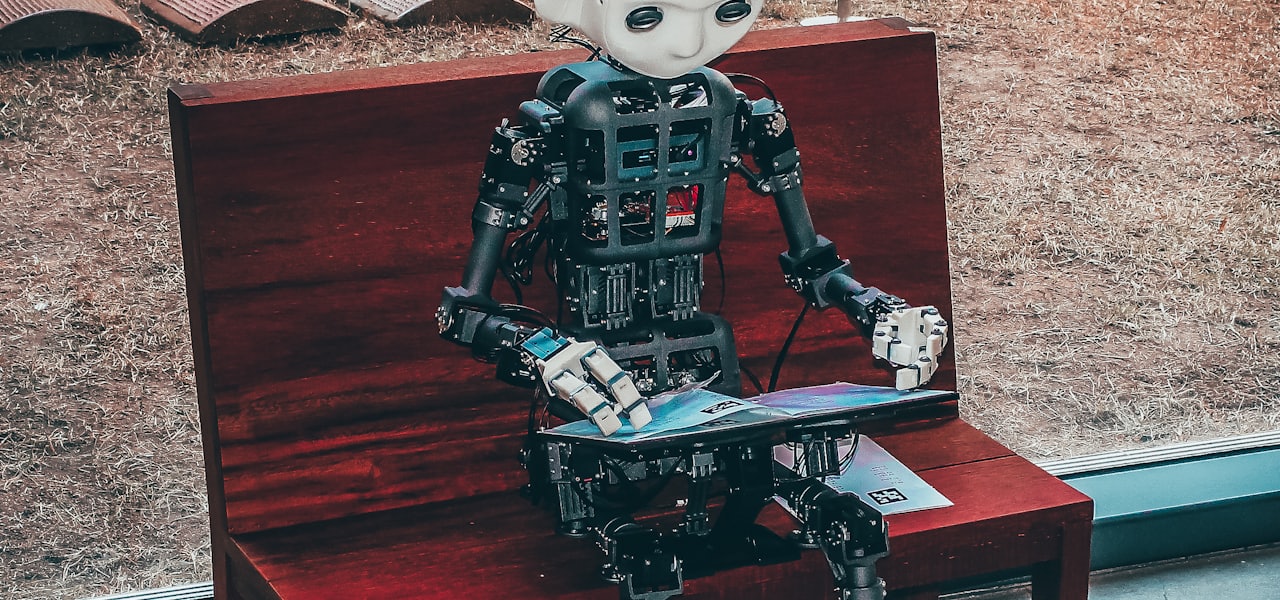
Workplace robotics safety is an aspect of occupational safety and health when robots are used in the workplace. This includes traditional industrial robots as well as emerging technologies such as drone aircraft and wearable robotic exoskeletons. Types of accidents include collisions, crushing, and injuries from mechanical parts. Hazard controls include physical barriers, good work practices, and proper maintenance. == Background == Many workplace robots are industrial robots used in manufacturing. According to the International Federation of Robotics, 1.7 million new robots are expected to be used in factories between 2017 and 2020. Emerging robot technologies include collaborative robots, personal care robots, construction robots, exoskeletons, autonomous vehicles, and drone aircraft (also known as unmanned aerial vehicles or UAVs). Advances in automation technologies (e.g. fixed robots, collaborative and mobile robots, and exoskeletons) have the potential to improve work conditions but also to introduce workplace hazards in manufacturing workplaces. Fifty-six percent of robot injuries are classified as pinch injuries and 44% of injuries are classified as impact injuries. A 1987 study found that line workers are at the greatest risk, followed by maintenance workers, and programmers. Poor workplace design and human error caused most injuries. Despite the lack of occupational surveillance data on injuries associated specifically with robots, researchers from the US National Institute for Occupational Safety and Health (NIOSH) identified 61 robot-related deaths between 1992 and 2015 using keyword searches of the Bureau of Labor Statistics (BLS) Census of Fatal Occupational Injuries research database (see info from Center for Occupational Robotics Research). Using data from the Bureau of Labor Statistics, NIOSH and its state partners have investigated 4 robot-related fatalities under the Fatality Assessment and Control Evaluation Program. In addition the Occupational Safety and Health Administration (OSHA) has investigated robot-related deaths and injuries, which can be reviewed at OSHA Accident Search page. Injuries and fatalities could increase over time because of the increasing number of collaborative and co-existing robots, powered exoskeletons, and autonomous vehicles into the work environment. Safety standards are being developed by the Robotic Industries Association (RIA) in conjunction with the American National Standards Institute (ANSI). On October 5, 2017, OSHA, NIOSH and RIA signed an alliance to work together to enhance technical expertise, identify and help address potential workplace hazards associated with traditional industrial robots and the emerging technology of human-robot collaboration installations and systems, and help identify needed research to reduce workplace hazards. On October 16 NIOSH launched the Center for Occupational Robotics Research to "provide scientific leadership to guide the development and use of occupational robots that enhance worker safety, health, and well being". So far, the research needs identified by NIOSH and its partners include: tracking and preventing injuries and fatalities, intervention and dissemination strategies to promote safe machine control and maintenance procedures, and on translating effective evidence-based interventions into workplace practice. == Hazards == Many hazards and injuries can result from the use of robots in the workplace. Some robots, notably those in a traditional industrial environment, are fast and powerful. This increases the potential for injury as one swing from a robotic arm, for example, could cause serious bodily harm. There are additional risks when a robot malfunctions or is in need of maintenance. A worker who is working on the robot may be injured because a malfunctioning robot is typically unpredictable. For example, a robotic arm that is part of a car assembly line may experience a jammed motor. A worker who is working to fix the jam may suddenly get hit by the arm the moment it becomes unjammed. Additionally, if a worker is standing in a zone that is overlapping with nearby robotic arms, he or she may get injured by other moving equipment. There are four types of accidents that can occur with robots: impact or collision accidents, crushing and trapping accidents, mechanical part accidents, and other accidents. Impact or collision accidents occur generally from malfunctions and unpredicted changes. Crushing and trapping accidents occur when a part of a worker's body becomes trapped or caught on robotic equipment. Mechanical part accidents can occur when a robot malfunctions and starts to "break down", where the ejection of parts or exposed wire can cause serious injury. Other accidents at just general accidents that occur from working with robots. There are seven sources of hazards that are associated with human interaction with robots and machines: human errors, control errors, unauthorized access, mechanical failures, environmental sources, power systems, and improper installation. Human errors could be anything from one line of incorrect code to a loose bolt on a robotic arm. Many hazards can stem from human-based error. Control errors are intrinsic and are usually not controllable nor predictable. Unauthorized access hazards occur when a person who is not familiar with the area enters the domain of a robot. Mechanical failures can happen at any time, and a faulty unit is usually unpredictable. Environmental sources are things such as electromagnetic or radio interference in the environment that can cause a robot to malfunction. Power systems are pneumatic, hydraulic, or electrical power sources; these power sources can malfunction and cause fires, leaks, or electrical shocks. Improper installation is fairly self-explanatory; a loose bolt or an exposed wire can lead to inherent hazards. === Emerging technologies === Emerging robotic technologies can reduce hazards to workers, but can also introduce new hazards. For example, robotic exoskeletons can be used in construction to reduce load to the spine, improve posture, and reduce fatigue; however, they can also increase chest pressure, limit mobility when moving out of the way of a falling object, and cause balance problems. Unmanned aerial vehicles are being used in the construction industry to do monitoring and inspections of buildings under construction. This reduces the need for humans to be in hazardous locations, but the risk of a UAV collision presents a hazard to workers. For collaborative robots, isolation is not possible. Possible hazard controls include collision avoidance systems, and making the robot less stiff to lessen the impact force. Robotic tech vest is a wearable device for humans, worn in Amazon warehouses. == Hazard controls == There are a few ways to prevent injuries by implementing hazard controls. There can be risk assessments at each of the various stages of a robot's development. Risk assessments can help gather information about a robot's status, how well it is being maintained, and if repairs are needed soon. By being aware of the status of a robot, injuries can be prevented and hazards reduced. Safeguarding devices can be implemented to reduce the risk of injuries. These can include engineering controls such as physical barriers, guard rails, presence-sensing safeguarding devices, etc. Awareness devices are usually used in conjunction with safeguarding devices. They are usually a system of rope or chain barriers with lights, signs, whistles, and horns. Their purpose it to be able to alert workers or personnel of certain dangers. Operator safeguards can also be in place. These usually utilize safeguarding devices to protect the operator and reduce risk of injury. Additionally, when an operator is within close proximity of a robot, the working speed of the robot can be reduced to ensure that the operator is in full control. This can be done by placing the robot in the manual or teach mode. It is also crucial to inform the programmer of the robot of what type of work the robot will be doing, how it will interact with other robots, and how it will work in relation to an operator. Proper maintenance of robotic equipment is also critical in order to reduce hazards. Maintaining a robot insures that it continues to function properly, thereby reducing the risks associated with a malfunction. One common safeguard used in industrial settings is the installation of robot safety fencing. These barriers, often made from durable materials such as mesh or polycarbonate, prevent accidental interactions between workers and robotic systems, reducing the risk of injury. Robot safety fencing is particularly important in environments where high-speed or powerful robots are used. == Regulations == Some existing regulations regarding robots and robotic systems include: ANSI/RIA R15.06 OSHA 29 CFR 1910.333 OSHA 29 CFR 1910.147 ISO 10218 ISO/TS 15066 ISO/DIS 13482
General Internet Corpus of Russian
General Internet Corpus of Russian (GICR) is a corpus of Russian internet texts that has been accessible on request through an online query interface since 2013. The corpus includes rich text materials from the blogosphere, social networks, major news sources and literary magazines. == Goals of the project == The project has the status of an educational and scientific one, and many tasks of computational linguistics are solved by independent researchers and research groups with the materials obtained by GICR. While other corpus projects of Russian are focused on fiction and edited texts, General Internet Corpus provides linguists timely opportunity to learn the language as it is, with all the slang and regional peculiarities. Corpus gives the opportunity to carry out research in Linguistic research of a wide range: dialectological research, study of word distribution, study of the language of the social networks, study of the influence of gender, age and other factors on the language, frequency of words, fixed expressions and different constructions, stylistic features of texts of different segments of the Internet, etc. Social media analysis Corpus-based machine learning for evaluating automatic tagging At various times, student papers and independent researches were carried out on the project material by students, graduates and employees of MSU, MIPT, Russian State Humanitarian University, Novosibirsk State University, Higher School of Economics, Russian Academy of Sciences, SFU, CSU, SGMP, IAAS of MSU. Scientific project leaders: Belikov V. - RSUH, Moscow, Russia Selegey V. - RSUH, ABBYY, Moscow, Russia Sharoff S. - RSUH, Moscow, Russia; University of Leeds, UK The organizations involved in support of GICR: Russian State University of Humanities ABBYY Company Moscow Institute of Physics and Technology Skolkovo Institute of Science and Technology == Size and content of the corpus == Corpus size for the summer 2016 is 19.8 billion tokens, of which 49% are from VKontakte, 40% are from LiveJournal, another 4% - from Mail.ru Blogs and News, and 2% - from Russian Magazine Hall. The sources collected in news segment are: RIA Novosti, Regnum, Lenta.ru, Rosbalt. Texts are provided with metamarkup (by date of creation of the text, sex, place and year of birth of the author, Internet genre, etc.); all texts are provided with automatic morphological tagging and lemmatization. Most of the texts collected are of 2013–2014 years of creation, although in some segments, such as in Russian Magazine Hall, there are some texts collected since 1994. GICR is one of the few mega-corpora projects nowadays, which means its available size is reaching several billion of words. == Access == Currently the interface of GICR is in beta stage, so access to the search in the corpora is provided and is free, but is available for researchers on request.